Venezuelan President Arraigned in Manhattan; Trump Declares U.S. “In Charge” of Region
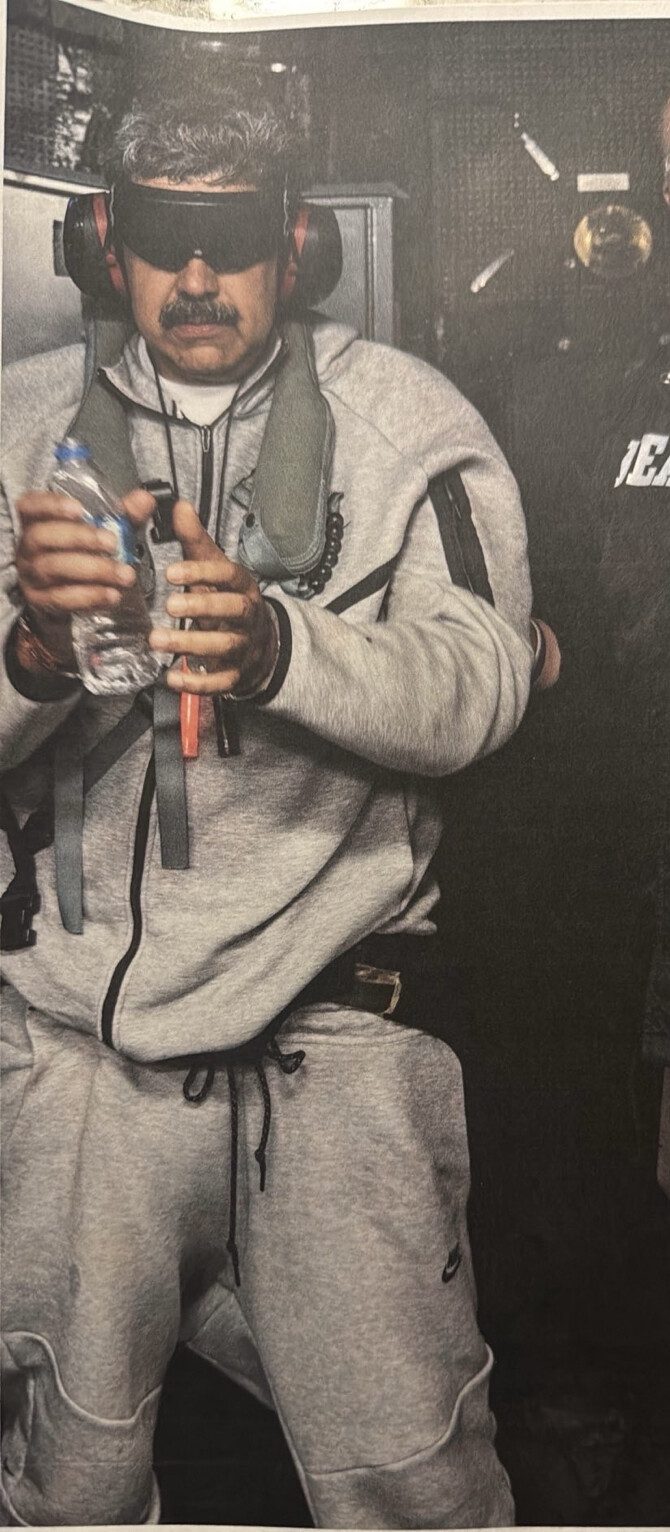
Nicolás Maduro, the Venezuelan president captured in a U.S. military operation over the weekend, pleaded not guilty Monday to federal narco-terrorism charges in a Manhattan courtroom.
Maduro and his wife, Cilia Flores, were seized early Saturday from their residence on a military base in Caracas during what the Trump administration described as a “surgical law enforcement operation.” The couple was flown to the United States on a warship and held at the Metropolitan Detention Center in Brooklyn before being transported via helicopter and armored motorcade to the federal courthouse in Lower Manhattan for their arraignment.
In a press gaggle on Air Force One, when President Donald Trump was asked if he had talked to oil companies before the Maduro raid, he answered that he had spoken with “basically” all of them “before and after” the operation, adding: “And they wanna go in. And they’re gonna do a great job for the people of Venezuela. And they’re gonna represent us well.”
Congress’ “Gang of Eight” and other key members received a classified briefing after the operation, and lawmakers are now pushing a War Powers resolution to restrict further action in Venezuela. The Constitution gives Congress the power to declare war, and the War Powers Resolution and related laws require notification and, for sustained hostilities, authorization from Congress.
Appearing before U.S. District Judge Alvin Hellerstein, both defendants entered not guilty pleas to an indictment unsealed Saturday by Attorney General Pam Bondi. The charges against Maduro include narco-terrorism conspiracy, conspiracy to import cocaine, possession of machineguns and destructive devices, and conspiracy to possess machineguns and destructive devices—offenses that carry potential life sentences.
“I am not guilty. I am innocent. I am a decent man,” Maduro declared through an interpreter, adding that he remains “still president of my country.”
The indictment alleges that Maduro and his associates collaborated with drug cartels to facilitate the shipment of thousands of tons of cocaine into the United States through Caribbean and Central American routes dating back to 1999. It also accuses the couple of ordering kidnappings, beatings, and murders against those who owed them drug money or threatened their trafficking operations, including the assassination of a local drug boss in Caracas. Flores is charged with accepting hundreds of thousands of dollars in bribes to arrange a meeting between a large-scale drug trafficker and Venezuela’s National Anti-Drug Office director.
The prosecution of Maduro stands in striking contrast to Trump’s pardon last month of former Honduran President Juan Orlando Hernández, who had been convicted on nearly identical charges.
Hernández was sentenced to 45 years in federal prison in June 2024 after a jury found him guilty of conspiring with drug traffickers to import more than 400 tons of cocaine into the United States. The conviction came after prosecutors presented evidence that Hernández used his position to protect traffickers with machine guns and grenade launchers in exchange for millions in bribes.
On December 1, 2025, Trump granted Hernández a “full and complete pardon,” claiming the former Honduran leader had been “treated very badly and very unfairly” by the Biden administration. Trump’s pardon announcement came just days before Honduras’ presidential election and was seen as an effort to support the right-leaning National Party candidate.
When questioned Saturday about the apparent contradiction, Trump said, “The man that I pardoned, if you want to look at it, he was treated the same exact way the Biden administration treated a man named Trump,” the president said.
Trump has also granted clemency to approximately 100 people accused of drug-related crimes during his two terms
Speaking to reporters aboard Air Force One on Sunday, Trump declared: “We’re in charge” of Venezuela.
Trump administration officials have not offered a date or plans for elections in Venezuela.
The president has framed these actions as a revival of the Monroe Doctrine, the 1823 declaration asserting U.S. dominance in the Western Hemisphere. “American dominance in the western hemisphere will never be questioned again,” Trump declared. He added that the U.S. is “prepared to conduct a second and much larger attack if necessary.”
Trump has also suggested that U.S. oil companies would enter Venezuela to rehabilitate infrastructure and generate revenue, though Secretary of State Marco Rubio stated Sunday that the U.S. would not govern Venezuela on a day-to-day basis beyond enforcing an existing “oil quarantine.”
The president warned interim Venezuelan leader Delcy Rodríguez, who took over following Maduro’s capture, according to Venezuela’s supreme court, that she could face a fate “probably worse than Maduro” if she fails to cooperate with Washington. Trump stated that Rodríguez had engaged in a “gracious” discussion with Secretary of State Marco Rubio, saying, “We’ll do whatever you need,” but said that “she really has no choice.” While initially appearing conciliatory, she later asserted that Maduro is “the only president of Venezuela” and demanded his “immediate liberation.”
Trump has openly threatened or hinted at possible U.S. military or coercive action this week against several countries beyond Venezuela, most prominently Colombia, Mexico, Cuba, Greenland, and Iran.
Trump has described Colombia as a “very sick” country and suggested possible U.S. military action or strikes unless it curbs cocaine production, responding “It sounds good to me” when asked about an operation there. He has warned Mexico to “get its act together,” again portraying it as run by drug cartels and reiterating offers to send U.S. forces to “eliminate the cartels,” implying consequences if it refuses. And Trump has said Cuba is “ready to fall” after Maduro’s capture and has floated it as a potential future target, even as he has suggested it may collapse without direct U.S. action.
Beyond Latin America, Trump has revived talk about bringing Greenland under U.S. control, alarming Denmark and European allies and signaled that Tehran remains on a list of states he is publicly menacing.
United Nations Security Council Secretary-General António Guterres released the following statement.
“The Secretary-General is deeply alarmed by the recent escalation in Venezuela, culminating with today’s United States military action in the country, which has potential worrying implications for the region,” said a statement issued by UN Spokesperson Stéphane Dujarric.
“Independently of the situation in Venezuela, these developments constitute a dangerous precedent. The Secretary-General continues to emphasize the importance of full respect – by all – of international law, including the UN Charter,” the statement continued.
“He’s deeply concerned that the rules of international law have not been respected.”
At an emergency UN Security Council Meeting on Monday, Russia and China led calls for Maduro’s immediate release, labeling the operation a violation of the UN Charter. The French deputy ambassador condemned the action, stating it “contradicts the principles of peaceful dispute resolution and the non-use of force”. Brazil, Colombia, Mexico, and several other Latin American nations joined in condemning the Trump administration’s military operations.